
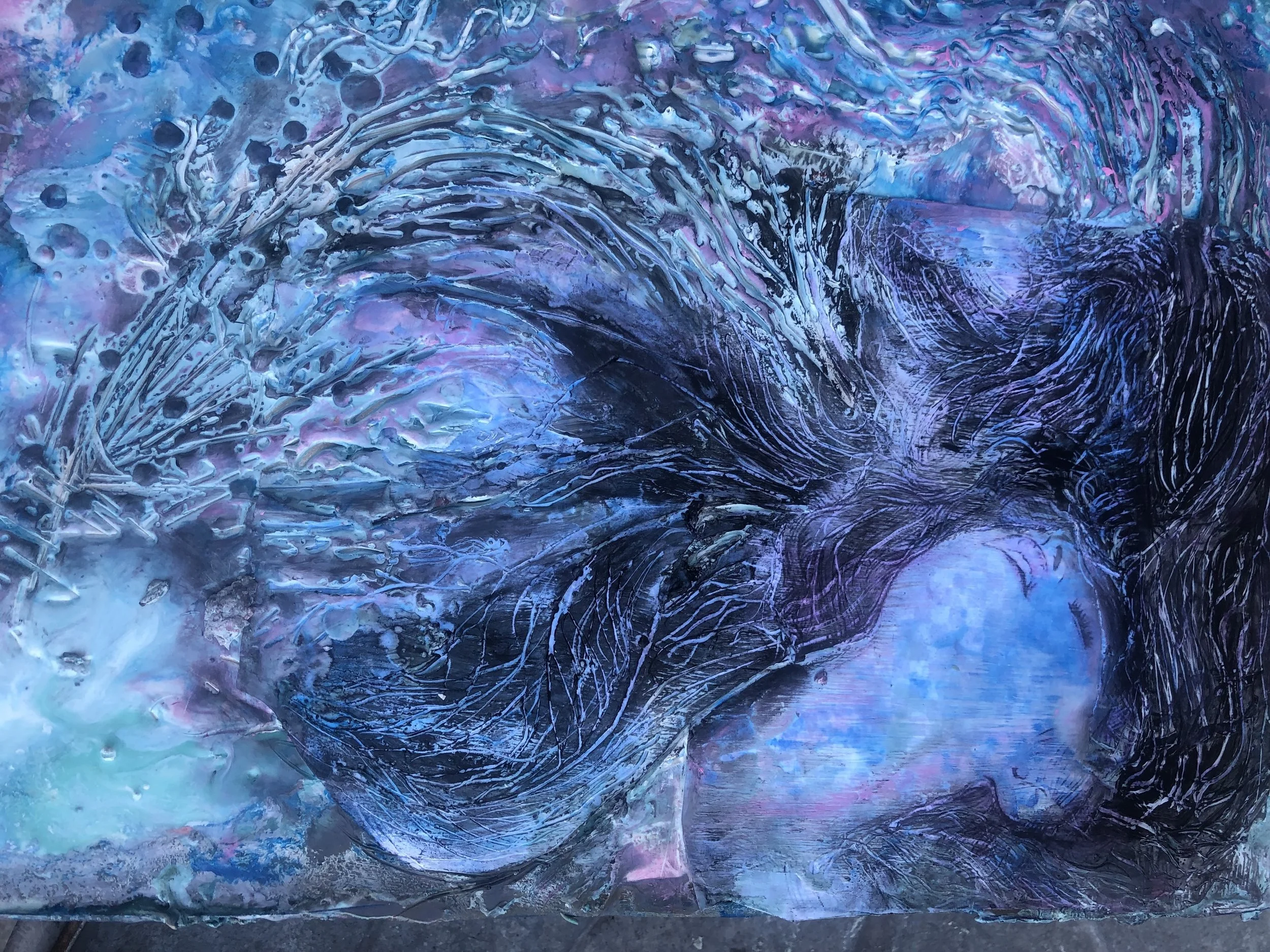

Drown, 9X12, 2019, Encaustic Photography on birchwood panel.
The blank slate. Tabula rasa. It is a mystery to sit in front of a blank slate, a blank canvas, a white page. The first touch of the creative process surges anticipation, trepidation, and excitation. This is one of the greatest gifts of creation—the ability it gives you to know yourself. This is the key also to its healing power. My healer is called encaustic. It was during a psychic crisis that I delved intensively into the process of creating with encaustic for a period of two years. The medium and the process it demanded embarked me on a process of knowing the deepest, darkest layers of myself. I had begun to dive into the wreck in a project I term psychic archeology.
I first delved into encaustic during the period of time my second marriage fell apart. The pain of another failed family drove me to find an outlet for my anguish. I had been entranced by the Fayuum portraits in the Hellenistic section of the Metropolitan Museum of Art. Those faces with haunting, deep-set eyes stared back at me so alive. Ironically these funerary masks depicting the deceased at an earlier time would be buried never to see the light of day until they were unearthed hundreds of years later. The technique that explained their medium “Encaustic” I had never heard of before. This led me down a rabbit hole. I learned that it is one of the most ancient painting techniques that used fire to fuse layers of natural beeswax and resin with dried pigments. It had the ability to preserve and waterproof the porous material, usually wood, it would be painted on. “En-kausticos” comes from the Greek meaning to “burn into.” The medium must be warmed and applied in layers onto the surface, each layer fused by more heat. You can literally paint with fire.
It was my good fate that one of the largest suppliers of encaustic paint gave workshops only an hour and a half away in upstate New York. From the first touch of the warm wax spreading in undulating molten waves along the panel, what with the sweet scent that reminded me of lighting the beeswax candles in my Orthodox church, and the meditative rhythm of fusing the layers again and again–I was mesmerized. It was as if I had intuitively unearthed a part of myself that I had buried for aeons. As it was the method used to paint ancient Greek statues, it provided a direct connection to my ancestral past.
As enthralling as it was, wax had a mind of its own. It is a fluid medium and hard to control. The beauty of encaustic lies in the dance between your will and the wax’s. It is like life. You appear in front of the panel with an intention, a will, a want and then you work the wax to bring it into being. Sometimes the wax resists, the way life denies you your desire. You can walk away in frustration or else stay the course and allow the wax to work through you to birth what it needs at this particular moment, at this particular place. On some days, try as I might there is no way to warp the wax to make it do as I want. That is when I have to let go. Stop insisting, stop controlling. When I let the wax do what it wants, the work tends to come out better anyway. This is the wisdom of wax: Let it flow. Just center yourself. Uncensor your conscious thoughts. The repetition of prep, paint, burn-- over and over creating the many luminescent layers that encaustic is known for--becomes a meditation. Like the many layers of a person’s soul, the wax works to untether those unconscious thoughts which speak, swivel and appear through the medium. It is therapeutic as well as beautiful.
But it was frightening. It is like diving into a pelagic sea, the sea that is my own psyche. ( I think this is why I kept creating and recreating ocean scenes of cool cerulean hues.) I spent many hours afraid to start. I dreaded the ugliness and disappointment that might emerge from those depths, the proof that would reinforce the negative feelings I had about myself, that I would give birth to gorgons because I was ugly. I was afraid to dive into the depths, afraid of what I might find there—monsters, mermaids, kraken, pearls? Perhaps I would not be able to come back up alive.
But I kept showing up, engaging in the process–night after night.
When I first started creating in wax in all sincerity and seriousness, what I brought up from my many dives were trinkets from the shipwrecks that were my life: forgotten fragments of pain from a brutal childhood of poverty, traumas like wounded tentacles, broken self-esteem like bleeding anemones. The more I struggled to reach the depths of my own psyche, the more the weight of bringing it to consciousness bore down on me. The struggle to bring forth a work that I actually liked disturbed the sea beds of shame at the sea bottom. The brokenness of my dreams, a youth cheated of its potential, the billows of despair, unfathomable, that drowned me.
Sometimes I could not come up for air and died in the abyss of my grief. All those parts of sunken ships that I so wanted to bury and forget. The wrestling match with wax, a stubborn medium that easily becomes a harsh task master over you, carried me to the bottom. A lot of detritus and rubble were kicked up. In those sea bottoms disturbed after centuries of salty slumber I found carcasses—sense memories of my father slapping me, self-hatred and self-sabotaging a career as a journalist, disgust and betrayal over two divorces. Images attached to these sense impressions surfaced. Encaustic is a very visceral process: you burn the wax, you chisel and destroy, pull back layers and then build them up again, you fuse layers over and over and over. It activates the mind, heart, and body.
The process has as much to do with destruction as construction. It is easy to destroy what you create in encaustic because you apply too much flame to the molten wax. Fire obliterates all and creates a semi-clean slate that forces me to bring forth new forms. The technique forces me to destroy the layers I have worked hard to pile up, disturbing surfaces forcing me to dig deeper. It is visceral and embodied: I use dental picks, scrapers, scalpels to chisel marks and scrape back the layers of what I buried 10 layers ago. And then comes the fire that pushes back the wax like rivulets of clear lava, sometimes scorching everything in its path. Build, destroy, build, destroy, build again.
The idea of destruction as a creative force is primordial. New species are created from the extinction of older ones. The butterfly digests its members to recreate a new body. Breaking down to build up from the pieces left behind. So in encaustic I make sure to obliterate, to destroy, to gouge, poke holes and make sure the marks of destruction show through the whole. Ultimately this is a law of the psychic universe too. You must destroy something in yourself to make room for something new to come forth. The way to creation is through destruction, and working in encaustic is a perfect embodiment of this principle.
While I worked away at the wax, I would begin to hear the subconscious echoes of my unworthiness. They became like a running monotone in my mind—“you are worthless; your life is a failure; you deserve to rot; you ruin everything around you.” All the while I kept pinging and creating. This was the remedy—for the first time I could hear the subterranean secrets out loud. I could also feel them in my body.
After many iterations of the process of working in wax, a strange thing then began to happen. As I pushed further into the creative process, another voice akin to a third eye, a meta-voice emerged. It was the voice of my Higher Power. It whispered without words that I was a child of God, that I was beautiful because I am, just as I was. I had to do nothing else but bask in His Light and His Love. I was loved and could love. It was that illumination that broke through the chaotic darkness of my primordial junk and slime. Not only was I able to accept those messages from the subaquatic primordial world they were forged in, but I was also able to rise above them. I broke through the surface screaming: “I am worthy, damn it! I am beautiful! I deserve to be loved.”
Working in wax taught me how to plunge into the depths, examine what had been buried for ages. I fathomed myself, deeply, for the first time, something I had not been able to do in a therapist’s office. I found that what I fished were both monsters and treasures: medusas and man-a-wars undulating with toxins, anemones bursting in purple stars, gorgons that can both kiss and drown you in their body. That abyss that is the soul, that unfathomable psyche, is what the creative process allows each diver to delve into like a bathyscafe.
With time, this very process of creating, with wax in particular, of diving into the deepest self, gave me joy, comfort and confidence. I started to trust myself for the first time—to believe that no matter how deep and dark I plunged, what emerged would be beautiful and scintillating and seductive, because it came from me, from the depths of me.
The creative process that starts with that one stroke, that one scribble, that one dash—this is what healed me, what revealed my inner depths to me. Every time I sit down or stand in front of an empty page, a blank canvas, it is like Diving into the Wreck as Adrienne Rich wrote. It is by diving into the deepest darkest depths that I emerge with the treasure of my self-knowledge, the pearl of great price.